On Prada’s A.I. fashion campaign
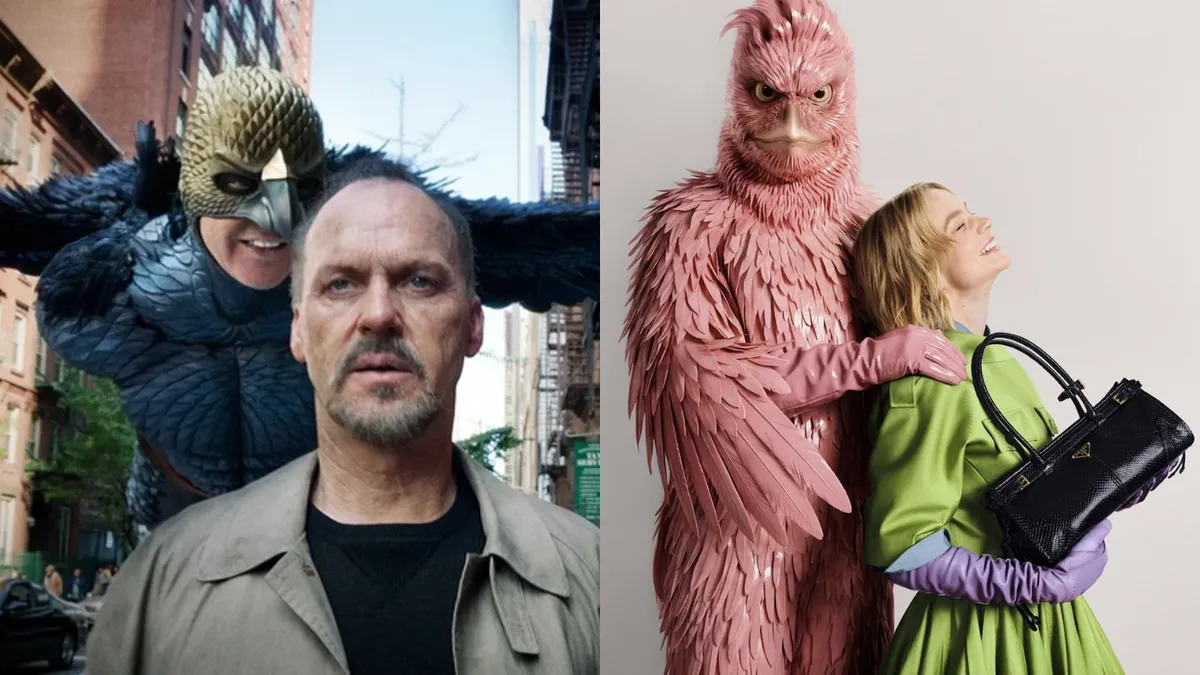
DO BILLIONAIRE DESIGNERS DREAM OF A.I. BIRDS?
I recently rewatched Birdman, a film which I thought I already understood when I first saw it at the age of 18, but now it shines with a different kind of brilliance. (One reward for getting older is that jokes about the human condition land even harder.) In Birdman, Michael Keaton plays Riggan Thomson, a washed-up Hollywood star who tries to reinvent himself as an artist by directing and writing and starring in his first Broadway play. In the days leading up to the play’s opening night, Riggan is terrorised by his ego, which in his mind takes the form of his most famous movie character: the winged and beaked Batman, I mean, Birdman.
Like Riggan, I am now being terrorised by a man in a bird costume. Prada released its Spring/Summer 2026 campaign featuring giant, garish birds—are they animation or A.I.? Apparently, they are the “artwork” of Jordan Wolfson, a white male American artist that the New Yorker once described as an edgelord.
Wolfson is known for his animatronic sculptures, which are built and programmed not by him but by a Hollywood special-effects studio. In the new Prada campaign, Wolfson’s birds look like creatures out of Monsters Inc, which may well have been his inspiration. “Wolfson’s reference-points are drawn from contemporaneous culture and our image-saturated society to create otherworldly characters,” explains Prada. “[Wolfson] invents unnamed, unreal, and dreamlike creatures, defined by complex visual imaging, that interact with the campaign cast in both stills and video—imagination made tangible.”
In Prada’s eerie campaign videos, Wolfson’s birds, as well as figures in shiny, scale-covered gimp suits, interact with actors Nicholas Hoult, Damson Idris, Carey Mulligan and Hunter Schafer, who each take turns struggling to say anything meaningful beyond the words “I am”. Prada says this is intentional: the statement is “is both declaration and proposition, left tantalizingly incomplete.”
The new campaign, Prada says, “opens ceaseless possibilities, multiplicities of identity and being, of what Prada can be, how it can be perceived, and re-perceived, through constantly-questioned conventions of an advertising campaign”.
Well, sure. But why birds? It’s not like Prada is partaking in the feather trend that has appeared in every other fashion brand’s Spring/Summer 2026 collections. In fact, the feathers and scales of Wolfson’s strange creatures only underscore how unadorned and plain Prada’s clothes are this season. The collection, says Miuccia Prada herself, represents a “new kind of elegance”. Raf Simons added that she and him also “talked a lot about freedom, but also freedom in the way you think about getting dressed.”
So maybe it comes down to something as simple as this: birds are a symbol of freedom. Birds and feathers are recurring motifs in Prada’s (and Miu Miu’s) collections. Prada loves Hitchcock, the director of The Birds. Let’s put big birds, as grotesque as the Labubus that our clients love, in the new Prada campaign. And let’s do it in a way that challenges the conventions of an advertising campaign, because we’re an Intellectual Fashion Brand and we take it upon ourselves to investigate the meaning of fashion.
At least, this is how I imagine the conversation about the new campaign went between Miuccia, Raf, Wolfson, and Prada’s art director Ferdinando Verderi. Verderi once told System Magazine, “The reason I relate to [Prada] and feel this chemical attraction is because Prada has led as a challenger brand; it has challenged the status quo and conventions of fashion… What I try to bring out in my work for Prada is the independent voice of a challenger, one that defies scale and the idea of a single-minded definition of itself, one that embraces fragmentation and rejects the idea that things are finished, perfect and sealed.” (Verderi studied philosophy in high school.)
I don’t know that Prada’s new campaign is actually challenging the conventions of fashion imagery, even if it is using A.I. The brand doesn’t elaborate on what type of “complex visual imaging” Wolfson used in his artwork, but the artist previously said that he has “played around with ChatGPT, and I’ve used DALL-E and other AI image generators in my work”.
Still, Prada is just the brand to embrace A.I.: Miuccia often talks about responding to “the now”, and the importance of embracing new technologies to remain relevant, which is why the brand has dabbled in projects involving the metaverse, NFTs and virtual reality. (Soon they’ll be making A.I. glasses with Meta!)
In any case, brands like Gucci and H&M have already beaten Prada at being the first to employ A.I. slop in fashion marketing. (Also LOL: remember when Balmain and Balenciaga “cast” CGI “models”?)
Even the practice of creating absurd or vexing images featuring celebrities, which can then become viral memes, is nothing new—that was the domain of Demna, Gucci’s current and Balenciaga’s former designer, in the 2010s. Juergen Teller, a photographer that Verderi admires, has also been creating that sort of imagery for years, most memorably for Loewe during Jonathan Anderson’s tenure.
Maybe Prada simply wants to piss people off—and it’s succeeding, going by the Instagram comments that I’ve seen so far—but that’s an old trick that even the American Eagle folks know how to pull off.
Or maybe Prada is confused. The campaign is at odds with the Spring/Summer 2026 collection, which according to Miuccia and Raf, was intended to offer a form of beauty and elegance, distilled in “response to the overload of contemporary culture”.
But Prada’s campaign, which doesn’t care to explain itself, and is left open to interpretation, simply adds to fashion’s barrage of meaningless images. It seems to me that Prada has surrendered to the machine. It’s not interested in what is human; in fact, the campaign’s real-life cast members, speaking like glitching androids, can barely tell you who they are. And as the viewer, you won’t notice them or their clothes anyway: your eye is drawn, instead, to what isn’t even real. The birds.
Maybe those birds are simply the hallucinations of a billionaire designer who is struggling to reconcile her communist learnings and political beliefs with her capitalist mode of living. She is hungry for expansion and wealth and power, but she is also hungry for art and meaning.
That same existential crisis plays out better in Birdman, if you ask me.
FURTHER READING:
Is AI Antithetical to Luxury? | Business of Fashion
Vogue Chaos Issue 22: Prada's AI-Angry Birds Campaign and Intellectualism | chaoswinter on Substack